Super compensatory substitutions restore protein function and confer mutational robustness
Curation statements for this article:-
Curated by eLife

eLife Assessment
This important study identifies and characterizes a set of amino acid states that can rescue protein function in the presence of substantially deleterious mutations. Some of these super-compensatory substitutions also confer substantial mutational robustness, with broader implications for understanding epistasis, protein evolution, and protein engineering. The evidence is compelling, supported by a creative reanalysis of a large deep-mutational-scanning dataset, experimental validation, an in-depth investigation of the evolutionary implications, and structural mechanistic analysis.
This article has been Reviewed by the following groups
Listed in
- Evaluated articles (eLife)
Abstract
Compensatory mutations can mitigate the fitness costs of deleterious mutations, yet their distribution, structural contexts, and evolutionary roles remain poorly characterized. Here, we systematically analyzed a public deep mutational scanning (DMS) dataset comprising ∼400,000 amino acid variants of imidazole glycerol-phosphate dehydratase (IGPD), with substitutions spanning the entire length of the protein. We found that roughly one-tenth of nonfunctional missense variants can regain function through additional substitutions, predominantly at solvent exposed residues with weak local contacts. Notably, we identified a distinct class of super compensatory substitutions that enhance fitness across diverse genetic backgrounds and buffer mutational effects, resulting in genotypes that occupy locally flatter regions of the fitness landscape. Comparative analyses of additional public DMS datasets across diverse proteins and assays revealed that super compensators recur across different natural sequence–function maps, indicating a broadly represented mode of compensatory effects that sustains mutational persistence and contributes to protein evolutionary robustness.
Article activity feed
-

eLife Assessment
This important study identifies and characterizes a set of amino acid states that can rescue protein function in the presence of substantially deleterious mutations. Some of these super-compensatory substitutions also confer substantial mutational robustness, with broader implications for understanding epistasis, protein evolution, and protein engineering. The evidence is compelling, supported by a creative reanalysis of a large deep-mutational-scanning dataset, experimental validation, an in-depth investigation of the evolutionary implications, and structural mechanistic analysis.
-
Reviewer #1 (Public review):
Summary:
The study identifies and characterizes a set of amino acid states that make the protein robust to other mutations, to the point of being able to compensate mutations that render wildtype proteins entirely non-functional. The study uses a previously published dataset and uses it to find and study such super-compensators. It then analyzes the biophysics and fitness landscape structure of what may be behind the compensation, identifying stability as an important parameter that, nevertheless, is not sufficient to explain all of the compensatory effect. These findings have important implications for our understanding of protein evolution, with these super-compensators possibly acting in a role of "permissive mutations" and open up evolutionary trajectories that may be closed without them. Perhaps the …
Reviewer #1 (Public review):
Summary:
The study identifies and characterizes a set of amino acid states that make the protein robust to other mutations, to the point of being able to compensate mutations that render wildtype proteins entirely non-functional. The study uses a previously published dataset and uses it to find and study such super-compensators. It then analyzes the biophysics and fitness landscape structure of what may be behind the compensation, identifying stability as an important parameter that, nevertheless, is not sufficient to explain all of the compensatory effect. These findings have important implications for our understanding of protein evolution, with these super-compensators possibly acting in a role of "permissive mutations" and open up evolutionary trajectories that may be closed without them. Perhaps the identification of such super-compensator substitutions can be incorporated into various protein design approaches.
Strengths:
The paper presents a compelling case with a rigorous analysis of the expected error rates of observation. While not unique, the current state-of-the-art in the field typically does include experimental error rate estimation like this work. The paper also does a good job in exploring the issue, including looking at plausible biophysical basis of super-compensators.
Comments on revised version.
The authors have addressed all of my concerns in the revision.
-
Reviewer #2 (Public review):
Summary:
This manuscript presents an interesting and conceptually valuable analysis of compensatory evolution using a large combinatorial deep-mutational-scanning dataset for yeast His3p.
Strengths:
I particularly like the identification of "super compensatory" substitutions that improve fitness across diverse genetic backgrounds and apparently reduce the sensitivity of the local fitness landscape to subsequent mutations. The work connects epistasis, protein stability, mutational robustness, and evolvability in a clear and potentially broadly relevant manner.
The authors provide several complementary lines of evidence in support of this central conclusion. In particular, the new experimental validation of S189A is an important strength because it directly demonstrates that a predicted super compensator can …
Reviewer #2 (Public review):
Summary:
This manuscript presents an interesting and conceptually valuable analysis of compensatory evolution using a large combinatorial deep-mutational-scanning dataset for yeast His3p.
Strengths:
I particularly like the identification of "super compensatory" substitutions that improve fitness across diverse genetic backgrounds and apparently reduce the sensitivity of the local fitness landscape to subsequent mutations. The work connects epistasis, protein stability, mutational robustness, and evolvability in a clear and potentially broadly relevant manner.
The authors provide several complementary lines of evidence in support of this central conclusion. In particular, the new experimental validation of S189A is an important strength because it directly demonstrates that a predicted super compensator can buffer the effects of diverse deleterious substitutions, while analyses of additional DMS datasets from other proteins and assay systems suggest that the phenomenon is not restricted to the original His3p landscape.
Comments on revised version.
The authors have satisfactorily addressed all of my previous concerns.
-
Reviewer #3 (Public review):
Summary:
The manuscript by Jiang and co-authors presents an analysis of experimental measurements (about 400k variants) from a deep mutational scan of HIS3 enzyme. The authors assess the ability of a genotype to be "rescued" and show that this depends on mutation sites (in particular their solvent accessibility) and mutations effects (should be mild on folding stability or binding affinity). They further identify a set of super-compensatory mutations and their results suggest that these mutations flatten the fitness landscape.
Strengths:
This finding is interesting and likely of interest to a broad community. The analysis seems sound.
Comments on revised version.
The authors have satisfactorily addressed my concern. Additional robustness experiments and case studies from ProteinGym are valuable.
-
Author response:
The following is the authors’ response to the original reviews.
eLife Assessment:
This important study identifies and characterizes a set of amino acid states that can rescue protein function in the presence of substantially deleterious mutations. Some of these super-compensatory substitutions also confer substantial mutational robustness, with broader implications for understanding epistasis, protein evolution, and protein engineering. The evidence is convincing, supported by a creative reanalysis of a large deep-mutational-scanning dataset, statistically rigorous treatment of anticipated error rates, experimental validation, and analyses of additional proteins, although clearer presentation and deeper investigation of the evolutionary implications and structural mechanisms would further strengthen the study.
We …
Author response:
The following is the authors’ response to the original reviews.
eLife Assessment:
This important study identifies and characterizes a set of amino acid states that can rescue protein function in the presence of substantially deleterious mutations. Some of these super-compensatory substitutions also confer substantial mutational robustness, with broader implications for understanding epistasis, protein evolution, and protein engineering. The evidence is convincing, supported by a creative reanalysis of a large deep-mutational-scanning dataset, statistically rigorous treatment of anticipated error rates, experimental validation, and analyses of additional proteins, although clearer presentation and deeper investigation of the evolutionary implications and structural mechanisms would further strengthen the study.
We sincerely thank the Reviewing Editor, the Senior Editor, and the three reviewers for this assessment. The two directions identified in it are addressed directly in the present revision. The structural mechanism of super compensation is now examined with an inverse-folding model in addition to the Rosetta calculations (Reviewer #2, Comment 1); the evolutionary implications are tested on a phylogeny rather than by co-occurrence among extant species, with the remaining limitations stated explicitly (Reviewer #2, Comment 3); and the presentation is revised throughout, including the title, the terminology used for fitness landscapes, the two section titles, the numbering of equations, and the figures (Reviewer #1). We hope that these revisions strengthen the clarity and the evolutionary interpretation of the study.
Reviewer #1 (Public review):
Summary:
The study identifies and characterizes a set of amino acid states that make the protein robust to other mutations, to the point of being able to compensate mutations that render wildtype proteins entirely non-functional. The study uses a previously published dataset and uses it to find and study such super-compensators. It then analyzes the biophysics and fitness landscape structure of what may be behind the compensation, identifying stability as an important parameter that, nevertheless, is not sufficient to explain all of the compensatory effect. These findings have important implications for our understanding of protein evolution, with these super-compensators possibly acting in a role of "permissive mutations" and opening up evolutionary trajectories that may be closed without them. Perhaps the identification of such super-compensator substitutions can be incorporated into various protein design approaches.
Strengths:
The paper presents a compelling case with a rigorous analysis of the expected error rates of observation. While not unique, the current state-of-the-art in the field typically does include experimental error rate estimation like this work. The paper also does a good job in exploring the issue, including looking at plausible biophysical basis of super-compensators.
We are deeply grateful to Reviewer #1 for the constructive feedback and the careful reading of our manuscript. We are particularly encouraged by the assessment that the paper “presents a compelling case with a rigorous analysis” of the expected error rates of observation, and by the recognition that the identification of super compensatory substitutions may inform protein design approaches. The comments on the rigor of the evolutionary framing, on the presentation of the fitness-potential analysis, and on the figures were highly valuable in improving the manuscript. We have carefully considered each point and itemize the corresponding revisions below.
Weaknesses:
(1) The paper lacks rigor in talking about evolutionary-related issues of the state of the fitness landscape. As an example, the paper mentions that these super-compensators flatten the landscape. While I understand where this is coming from, I think that the fitness landscape in this context is a static entity and cannot be flattened or otherwise altered. A much more accurate description is that a sequence with a super-compensator is located in a flatter-than-expected segment of the fitness landscape, or on a flat fitness ridge. These issues are more semantic in nature, and while the manuscript would benefit from it being shown to an expert in molecular evolution or fitness landscapes, this issue does not take away from the importance of the results.
We thank the reviewer for the suggestions. The proposed title is “Super-compensatory substitutions restore protein function and confer local mutational robustness”. The replacement text distinguishes the fixed genotype-to-fitness map from comparisons among local neighborhoods within that map. “Local mutational robustness” is defined operationally as a smaller absolute measured effect of the same second-site substitution in matched backgrounds carrying the focal state. The prepared prose removes statements that a substitution “flattens,” “smooths,” or changes the landscape and instead says that a genotype occupies a locally flatter region or fitness ridge.
Reviewer #1 (Recommendations for the authors):
I think that there should be more rigor when talking about or painting a mental picture of the fitness landscape (see above). More minor comments below:
Main text
(1) Line 106: "pooled competitive growth assays" -> is it correct to call it "competitive"? By design, there should not be competition in the sense that the presence or absence of cells with genotype A should not influence the growth rate of cells with genotype B.
We thank the reviewer for the careful terminology check. We fully agree that “competitive” is misleading here, as the assay does not measure direct competition between genotypes. We have revised the term to “pooled growth assays” throughout the manuscript to more accurately reflect the experimental design.
(2) Line 125: 3,750 rescuable genotypes are identified among 31,701 lethal ones (Line 111), but in the abstract the claim is one-third of non-functional missense variants are rescuable (Line 26-27). I am not sure I understand.
We thank the reviewer for catching this inconsistency. Upon re‑checking, we realize that 3,750/31,701 is approximately 11.8% (roughly one‑tenth), not one‑third. The “one‑third” figure in the Abstract was a misstatement and has been corrected to reflect the correct proportion. All other numbers in the main text and abstract have been cross‑checked and are consistent.
(3) Line 149: add citation to His3p being a homo-24-mer.
We thank the reviewer for the suggestion. The citation has been added accordingly (Rawson et al., 2018).
(4) Lines 178-187: I understood the paragraph about the fitness potential of super compensators, but I think that it should be shown to someone who does not think of fitness potentials as much as I do and see if it makes sense to them.
Please refer to the question 2 of reviewer 3
(5) Line 188: The title (and the paragraph) could focus on buffering beneficial ones; for deleterious, it is given by definition (although strictly only for lethals).
We thank the reviewer for the suggestion. We have revised the title to “Super Compensators Buffer the Effects of Beneficial Substitutions” to clearly emphasize that our study focuses on the buffering of beneficial mutations
(6) Line 238-239: Even more strongly than previously, the title is describing a property given by definition of (super) compensators, is it not?
We thank the reviewer for this critical and insightful point. We fully agree that the original title, “Super Compensators Enhance Organisms’ Tolerance to Deleterious Mutations,” risked stating a tautological property inherent to the definition of compensators. To address this, we revised it to “Validating Super Compensators as Robust Buffers of Deleterious Substitutions”, which now emphasizes the experimental validation aspect rather than a definitional property.
(7) Line 260: Regarding the robustness of the findings in other datasets - first, I did not see any results based on these datasets (maybe that is for another publication), and it is not clear which results are being referred to. Is it the existence of super-compensatory mutations, or their prevalence or their global stabilizing effect, or all of that?
We thank the reviewer for this important query. We have now clarified in the revised manuscript that our analysis of the other datasets was intended to test whether supercompensators can be detected in other proteins, not to estimate their global stabilizing effects. The results (Fig. S7A–B) show that such high‑compensation amino acid states do exist in other systems.
(8) Figure 1A: why does it jump in the diagram from WT 2 mutations away rather than 1?
We thank the reviewer for pointing out the inconsistency in Figure 1A. We have revised the figure as suggested, and the updated version now properly shows the stepwise progression from WT through the single‑mutation intermediate to the double‑mutation state, removing the original jump.
(9) Lines 655-656: Figure 1C dark blue vs black is hard to read.
We thank the reviewer for this suggestion. We have changed the dark blue to light blue in Figure 1C to enhance readability ‘
(10) Figure 2D: given axes, it would read better if it is a square.
We thank the reviewer for raising this issue. We have revised Figure 2D to a square (1:1) aspect ratio, as suggested, to improve readability. The updated figure is now included in the revised manuscript.
(11) Lines 681-682: when the definition of compensatory ability is the sum of incoming weights - although mathematically easiest, I am not sure what the sum represents. Because these weights are products, wouldn't a product be more natural? Not sure about this myself.
We thank the reviewer for raising this important issue. The graph direction to represent transitions from the existing background state to added substitutions. Each edge records the fraction of pairs showing a fitness increase ≥ 0.5. A product of incoming weights was not adopted because zero-valued weights would force the product to zero, obscuring differences in compensatory ability across substitutions.
Supplementary
(1) Figure S8 - the figure itself is confusing; I cannot connect it with the conclusion.
We apologize for the confusion caused by Figure S8. To address this, we have revised the figure layout and significantly expanded the legend to explicitly describe: (1) the origin and processing of the data, (2) the definition of the row/column of the heatmap, and (3) a direct interpretation to the corresponding conclusion. We believe the updated version now clearly conveys the intended message. The revised figure and legend are included in the updated supplementary materials.
(2) The font is inconsistent with the rest of the document.
We thank the reviewer for this careful observation. We have revised the font in the indicated section to match the formatting used throughout the manuscript. We have also reviewed the rest of the document to ensure overall formatting consistency.
We appreciate Reviewer #1’s careful comments on the rigor of the evolutionary framing and on the presentation of the manuscript. The revisions replace the landscape-altering language with statements about local neighborhoods, correct the inconsistent proportion reported in the Abstract, revise the two section titles so that they no longer restate a definitional property, number all equations, and improve the readability of Figures 1A, 1C, 2D, and S8.
Reviewer #2 (Public review):
Summary:
This manuscript presents an interesting and conceptually valuable analysis of compensatory evolution using a large combinatorial deep-mutational-scanning dataset for yeast His3p.
I particularly like the identification of "super compensatory" substitutions that improve fitness across diverse genetic backgrounds and apparently reduce the sensitivity of the local fitness landscape to subsequent mutations. The work connects epistasis, protein stability, mutational robustness, and evolvability in a clear and potentially broadly relevant manner.
The authors provide several complementary lines of evidence in support of this central conclusion. In particular, the new experimental validation of S189A is an important strength because it directly demonstrates that a predicted super compensator can buffer the effects of diverse deleterious substitutions, while analyses of additional DMS datasets from other proteins and assay systems suggest that the phenomenon is not restricted to the original His3p landscape.
We first appreciate Reviewer #2’s positive assessment of the conceptual value of the study, and in particular the recognition that the work connects epistasis, protein stability, mutational robustness, and evolvability, and that the new experimental validation of S189A is an important strength. We are also grateful for the three specific and constructive suggestions on structure-aware modelling, on the scope of the ProteinGym analysis, and on tree-aware testing of ortholog co-occurrence. These suggestions led to the largest additions in this revision. We have carefully considered each point, and our responses and the corresponding revisions are detailed below.
Weaknesses:
(1) The structural analysis currently relies primarily on correlations with RSA, weighted contact number, conservation, and Rosetta-predicted changes in folding or binding energy. For super compensators, the mechanistic evidence is largely limited to predicted stabilization and individual examples, such as the proposed salt bridge between 110D and R112. I believe that the newly developed structure-aware deep-learning approaches could provide useful information on the mechanism of super compensators. For example, an inverse-folding model such as ESM-IF1 could score complete multi-mutant sequences conditioned on the His3p backbone and test whether adding a super compensator restores sequence-structure compatibility across backgrounds. More recent multimodal mutation-effect or stability models could similarly be used to cross-check the Rosetta results, including models that explicitly support combinatorial mutations. I would not recommend simply comparing AlphaFold confidence scores between mutants, because current structure predictors are not necessarily sensitive to subtle mutation-induced energetic or conformational changes.
Following the reviewer's suggestion, we scored complete multi-mutant His3p sequences with ESM-IF1 (esm_if1_gvp4_t16_142M_UR50) conditioned on the 6EZM backbone, comparing exact measured genotype pairs that differ only by the state of interest (up to 1,000 backgrounds per state; 7,000 pairs). Five of the seven reported super compensatory substitutions in the Table S1 increased sequence–backbone compatibility: 144N (+0.0160), 169R (+0.0115), 110D (+0.0086), 189A (+0.0021) and 93V (+0.0016), each with a bootstrap interval excluding zero. Two decreased (73A, −0.0153; 137G, −0.0080). Against score-blind matched controls the contrast favoured the reported state for those same five (exact two-sided binomial P = 0.45). All seven directions were preserved in a contacting-chain context (chains A, R and L; Cα within 8 Å). We also used these scores to cross-check the archived Rosetta energies over the 1,217 exact pairs carrying archived entries on both sides (Zenodo 17769278). Higher archived energy accompanies lower measured fitness, so concordance would appear as a negative correlation; the observed Spearman correlations are positive (ρ = +0.085 to +0.094 pooled, +0.200 to +0.211 within focal state). The two predictors therefore do not track one another. We did not compare AlphaFold confidence scores between mutants.
In a word, ESM-IF1 supports the idea that most supercompensatory substitutions can promote the folding of His3p.
(2) The manuscript states that the pipeline was applied to 217 ProteinGym datasets and concludes that super compensators are broadly distributed across proteins and assays. However, this central generalization is described in only a few sentences and is largely relegated to Figure S7. The Methods do not explain which datasets contained sufficient combinatorial mutants to calculate compensatory ability or buffering, how many genotype pairs or quadruplets were available per substitution, or how differences in assay scale and library design were handled. This point requires clarification because super compensation is inherently a background-dependent property and cannot be established from single-mutant measurements alone. ProteinGym is widely used as a substitution-effect benchmark, and many of its constituent assays primarily contain single substitutions; for example, an analysis of an earlier ProteinGym collection reported that 76 of 87 assays contained only single substitutions. It is therefore unclear how the same compensatory-interaction pipeline could be applied uniformly to all 217 datasets.
We thank the reviewer for the suggestions. We have re-performed this analysis based on the pinned PG_v1.3 manifest. The 217 DMS assays cover 186 unique proteins. To identify super-competitors, we filtered for DMS datasets containing multiple substitutions per genotype—specifically requiring at least 10 sets of quadruplet genotypes to evaluate whether a specific amino acid state can mitigate mutational effects. This strict filtering yielded four qualified DMS datasets: three assayed for in vitro protein folding stability using cDNA display proteolysis (E3 ubiquitin-protein ligase AMFR, iron-regulated surface determinant protein H, and E3 SUMO-protein ligase CBX4; Tsuboyama et al., 2023), and one assayed for fluorescence intensity via FACS (green fluorescent protein 2; Gonzalez Somermeyer et al., 2022). We have updated the Methods section to detail this selection process.
(3) The analysis of 335 His3p orthologs in Discussion is potentially very interesting, but co-occurrence between super compensators and putatively deleterious amino-acid states does not by itself demonstrate evolutionary compensation. Closely related species share substitutions through common ancestry, and both states could be associated with a particular lineage or ecological context. A tree-aware analysis would considerably strengthen this result. The authors could reconstruct ancestral states and ask whether acquisition of a super compensator tends to precede or accompany otherwise deleterious substitutions. Alternatively, they could use phylogenetically informed permutations that preserve substitution frequencies and shared ancestry.
We agree. Co-occurrence among living species is not by itself evidence of compensation, because related species inherit substitutions from a common ancestor. We have therefore redone the analysis on a phylogeny, using the phylogenetically informed permutation the reviewer suggests.
We realigned the archived orthologs with MAFFT L-INS-i and built a maximum-likelihood tree with IQ-TREE: 329 species, 225 alignment columns, the Q. YEAST model selected by BIC, with 1,000 ultrafast-bootstrap and 1,000 SH-aLRT replicates. Six rows carrying three ambiguous duplicate species labels were removed, which also corrects the earlier figure caption that stated 355 species. We then tested 28 substitution pairs against a null in which both substitutions are simulated on the tree and thresholded to their observed frequencies, so the null preserves both how common each substitution is and how the species are related.
Two pairs stand out, and both involve 189A. 189A occurs together with 204I in 112 species, where the tree-based null expects 78 — an excess of 34 species. 189A occurs with 211E in 66 species against an expectation of 43 — an excess of 23. Both excesses are significant on their own under the tree-based simulation (p = 0.021 and 0.036, from 100,000 simulations) and under a separate Pagel test of correlated evolution (p = 0.046 and 0.023). No other pair reaches significance under both tests. 189A is also the substitution we validated experimentally, so the strongest evolutionary signal and the experimental result point to the same substitution.
We note two limits. Neither pair survives correction for having tested 28 pairs. And both pairs involve common substitutions (189A is present in 177 of the 329 species), so part of their high rank may reflect the greater statistical power available for common substitutions. We therefore present these as the strongest associations in the data rather than as proof of historical compensation.
We sincerely thank Reviewer #2 for recommending a broader mechanistic and evolutionary evaluation. The added ESM-IF1 analysis, the re-performed ProteinGym dataset selection, and the tree-aware analysis of ortholog co-occurrence provide more direct evidence for the properties of super compensatory substitutions, and we have stated the remaining limitations of each analysis explicitly.
Reviewer #3 (Public review):
The manuscript by Jiang and co-authors presents an analysis of experimental measurements (about 400k variants) from a deep mutational scan of the HIS3 enzyme. The authors assess the ability of a genotype to be "rescued" and show that this depends on mutation sites (in particular their solvent accessibility) and mutation effects (should be mild on folding stability or binding affinity). They further identify a set of super-compensatory mutations, and their results suggest that these mutations flatten the fitness landscape.
This finding is interesting and likely of interest to a broad community. The analysis seems sound. However, I have a number of major concerns regarding the presentation and positioning of the work.
We sincerely thank Reviewer #3 for the careful reading of our manuscript and for the positive comments that the finding is “interesting and likely of interest to a broad community” and that the analysis “seems sound.” The concerns regarding the positioning of the work relative to Pokusaeva et al. (2019), the description of the model used to estimate fitness potentials, the structural and citation details, and the sensitivity of rescuability to the threshold choices were valuable in improving the clarity and the rigor of the manuscript. We address each point below.
(1) It would improve the manuscript to clarify the present contribution with respect to a previous study by the same authors, namely Pokusaeva et al. 2019. Did the authors apply the same protocol to generate a new library of mutants, or did they re-analyse an already published library? If the library is not new, ambiguous sentences like "Nevertheless, to our knowledge, the His3p library remains one of the largest and most comprehensive resources that contains multi-site mutants" should be reformulated.
We thank the reviewer for noting this ambiguity; we agree and will revise accordingly. The large-scale His3p landscape was reported in Pokusaeva et al. (2019), and no new version was constructed here. Instead, we provide a computational re-analysis of those measurements to quantify rescuability, broad positive effects of super compensatory substitutions, and local buffering of fitness effects, plus a newly generated targeted DMS validation library (randomizing positions 181 and 202 in WT S189 vs. 189A) that experimentally validates compensation. To clarify provenance, we will change the sentence “Nevertheless, to our knowledge, the His3p library remains one of the largest...” to “While the large-scale library was measured previously (Pokusaeva et al., 2019), the current work combines a newly generated targeted dataset with a fresh re-analysis of this public His3p library to reveal previously unappreciated rules of compensation.” This revision clearly separates prior data from our novel contributions.
(2) Pokusaeva et al. 2019 is cited for the library and also for the deep neural network. It would be beneficial to briefly describe the architecture, the inputs and outputs, and the training procedure. Was the network trained on the current library? What is the purpose of this network? It looks more like an additive linear model (except for the global sigmoid) than a deep neural network. How does it relate to global epistasis models? The sigmoid function is designed to capture plateauing effects; doesn't that introduce some circularity issue in the reasoning?
Pokusaeva et al. (2019) describes a three-layer feed-forward model that is best understood as a global-epistasis model rather than a conventional deep neural network. The input is a one-hot encoding of amino-acid states. These inputs are first mapped to a one-dimensional additive latent variable, in which the state-specific coefficients are summed to produce a genotype-level latent “fitness potential.” That latent value is then passed through a learned nonlinear output layer with 22 units to generate the predicted fitness. The model was trained on the current library.
Its purpose is to separate the intrinsic contribution of each amino-acid state from the background-dependent saturation of the His3p assay. Raw fitness values are not directly comparable across genetic backgrounds: in already low-fitness backgrounds, additional substitutions may remain phenotypically invisible, whereas in high-fitness backgrounds, mildly deleterious effects may be masked. A global-epistasis formulation addresses this by placing states on an additive latent scale and capturing assay saturation through a monotonic nonlinear link function. In this framework, each state has an estimated coefficient that is interpreted as its background-independent fitness contribution.
This coefficient is not hypothetical; it is explicitly provided in File/DeepLearningWeights/DLWeightsFI.tsv as FI_mean, one row per state. These coefficients are used downstream to quantify each state’s fitness impact, which is essential for showing that supercompensatory substitutions are not defined in a circular way by construction.
(3) Are the super-compensatory mutations observed (conserved) across evolution? Beyond the fact that they are accompanied by mildly deleterious mutations in natural sequences. Can we predict them with variant effect predictors?
We thank the reviewer for these questions. Regarding evolutionary conservation, we have not performed a systematic phylogenetic analysis, as our primary focus here was the experimental characterization of compensation within the His3p system. Nevertheless, our data show that super‑compensatory mutations are consistently stabilizing across backgrounds (Fig. 4L)—precisely the property that makes them robustly beneficial regardless of context. This suggests that these mutations may be identifiable through stability‑predicting tools (e.g., FoldX, DeepDDG), which would flag them as stabilizing. Whether this stabilization is reflected in evolutionary conservation patterns is a separate question; while we observe their co‑occurrence with mildly deleterious variants in natural sequences (as the reviewer notes), we have not systematically tested whether conservation‑based predictors (e.g., EVE, DeepSequence) can predict them.
(4) The AAindex mention should be accompanied by a citation.
We thank the reviewer for the reminder. We will add the appropriate citation for the AAindex database in the revised manuscript
(5) Equations should be numbered. WCN formula seems to contain misformatting issues.
We thank the reviewer for the reminder. We numbered all equations sequentially and correct the formatting errors in the WCN formula.
(6) A more explicit description of the structural data analysed (which PDB entry?) should be provided.
We thank the reviewer for the reminder. The PDB entry used is 6EZM.
(7) I believe the citation Van Cleve and Weissman 2015 for the ProteinGym benchmark is incorrect. Additionally, is the Rosetta citation adequate?
We thank the reviewer for pointing out these citation issues. We have double-checked the references and agree with these concerns.
Regarding the Rosetta citation, we acknowledge that there is no single “Rosetta citation”. In our work, we used the ddg_monomer function for ΔΔG_fold calculations and the flex ddG function for ΔΔG of interface binding calculations. Therefore, we cited the corresponding methodological papers: Kellogg et al. (2011) for ddg_monomer and Barlow et al. (2018) for flex ddG.
(8) How is the definition of rescueability sensitive to the threshold choice?
We thank the reviewer for raising this important issue. To systematically evaluate the robustness of our rescuability measurements, we tested three key parameters: (i) the fitness cutoff used to define unfit genotypes, (ii) the minimum number of genotypes in the superset required for an unfit genotype to be considered and (iii) the fitness cutoff used to define fit genotypes. The first two parameters collectively determine the size of the unfit genotype set, while the third controls how rescuability was calculation.
As shown in Fig. S1D of the manuscript, varying the fitness cutoffs for defining both unfit and fit genotypes has only a minor effect on the calculated rescuability, as reflected by the highly correlated rescuability values across different cutoff combinations.
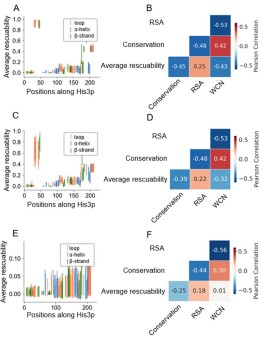
Besides, the primary goal was to examine how rescuability correlates with three biochemical features of each position in His3p: relative solvent accessibility (RSA), weighted contact number (WCN), and evolutionary conservation. When we applied different fitness cutoffs to define unfit genotypes while with at least 10 genotype in the superset, the correlations between rescuability and these biochemical features remained highly consistent (see Author response image 1A-D). This demonstrates that the observed associations between rescuability and RSA, WCN, and conservation are robust to the choice of fitness cutoff used to filter the unfit genotype sets.
We next assessed the sensitivity of our results to the superset (the whole genotypes with additional substitutions) threshold. Using a fixed fitness cutoff of zero to classify unfit genotypes, we found that, although this shifted the fraction of genotypes classified as unfit, the observed correlations between rescuability and the three biochemical features were largely unchanged, even when the superset was defined by as few as a single genotype (see Author response image 1E-F).
In summary, despite variations in the parameter settings used to filter unfit genotypes for rescuability calculation, the overarching conclusion—that rescuability is consistently correlated with RSA, WCN, and conservation—remains robust and reproducible across all tested conditions.
Author response image 1.
Different rescuability calculation methods and filtering thresholds produce similar results. (A-F) Different filtering thresholds used to calculate the average rescuability for each position of the monomer of His3p give similar results. (A-B) The average rescuability for each position along His3p for unfit genotype with fitness < 0.5. The total count of genotypes containing additional substitutions is at least 10. (C-D) The average rescuability for each position along His3p for unfit genotype with fitness < 1. The total count of genotypes containing additional substitutions is at least 10. (E-F) The average rescuability for each position along His3p for unfit genotype with fitness = 0 and the total count of genotypes containing additional substitutions is at least 1.
We are grateful to Reviewer #3 for the questions on data provenance, model description, structural data, citations, and threshold sensitivity. The revisions separate the previously published library from the newly generated targeted dataset, describe the global-epistasis model and its role explicitly, correct the citations, and document the robustness of rescuability across all tested filtering thresholds.
-

-
-

-
-
-
eLife Assessment
This important study identifies and characterizes a set of amino acid states that can rescue protein function in the presence of substantially deleterious mutations. Some of these super-compensatory substitutions also confer substantial mutational robustness, with broader implications for understanding epistasis, protein evolution, and protein engineering. The evidence is convincing, supported by a creative reanalysis of a large deep-mutational-scanning dataset, statistically rigorous treatment of anticipated error rates, experimental validation, and analyses of additional proteins, although clearer presentation and deeper investigation of the evolutionary implications and structural mechanisms would further strengthen the study.
-
Reviewer #1 (Public review):
Summary:
The study identifies and characterizes a set of amino acid states that make the protein robust to other mutations, to the point of being able to compensate mutations that render wildtype proteins entirely non-functional. The study uses a previously published dataset and uses it to find and study such super-compensators. It then analyzes the biophysics and fitness landscape structure of what may be behind the compensation, identifying stability as an important parameter that, nevertheless, is not sufficient to explain all of the compensatory effect. These findings have important implications for our understanding of protein evolution, with these super-compensators possibly acting in a role of "permissive mutations" and opening up evolutionary trajectories that may be closed without them. Perhaps the …
Reviewer #1 (Public review):
Summary:
The study identifies and characterizes a set of amino acid states that make the protein robust to other mutations, to the point of being able to compensate mutations that render wildtype proteins entirely non-functional. The study uses a previously published dataset and uses it to find and study such super-compensators. It then analyzes the biophysics and fitness landscape structure of what may be behind the compensation, identifying stability as an important parameter that, nevertheless, is not sufficient to explain all of the compensatory effect. These findings have important implications for our understanding of protein evolution, with these super-compensators possibly acting in a role of "permissive mutations" and opening up evolutionary trajectories that may be closed without them. Perhaps the identification of such super-compensator substitutions can be incorporated into various protein design approaches.
Strengths:
The paper presents a compelling case with a rigorous analysis of the expected error rates of observation. While not unique, the current state-of-the-art in the field typically does include experimental error rate estimation like this work. The paper also does a good job in exploring the issue, including looking at plausible biophysical basis of super-compensators.
Weaknesses:
The paper lacks rigor in talking about evolutionary-related issues of the state of the fitness landscape. As an example, the paper mentions that these super-compensators flatten the landscape. While I understand where this is coming from, I think that the fitness landscape in this context is a static entity and cannot be flattened or otherwise altered. A much more accurate description is that a sequence with a super-compensator is located in a flatter-than-expected segment of the fitness landscape, or on a flat fitness ridge. These issues are more semantic in nature, and while the manuscript would benefit from it being shown to an expert in molecular evolution or fitness landscapes, this issue does not take away from the importance of the results.
-
Reviewer #2 (Public review):
Summary:
This manuscript presents an interesting and conceptually valuable analysis of compensatory evolution using a large combinatorial deep-mutational-scanning dataset for yeast His3p.
Strengths:
I particularly like the identification of "super compensatory" substitutions that improve fitness across diverse genetic backgrounds and apparently reduce the sensitivity of the local fitness landscape to subsequent mutations. The work connects epistasis, protein stability, mutational robustness, and evolvability in a clear and potentially broadly relevant manner.
The authors provide several complementary lines of evidence in support of this central conclusion. In particular, the new experimental validation of S189A is an important strength because it directly demonstrates that a predicted super compensator can …Reviewer #2 (Public review):
Summary:
This manuscript presents an interesting and conceptually valuable analysis of compensatory evolution using a large combinatorial deep-mutational-scanning dataset for yeast His3p.
Strengths:
I particularly like the identification of "super compensatory" substitutions that improve fitness across diverse genetic backgrounds and apparently reduce the sensitivity of the local fitness landscape to subsequent mutations. The work connects epistasis, protein stability, mutational robustness, and evolvability in a clear and potentially broadly relevant manner.
The authors provide several complementary lines of evidence in support of this central conclusion. In particular, the new experimental validation of S189A is an important strength because it directly demonstrates that a predicted super compensator can buffer the effects of diverse deleterious substitutions, while analyses of additional DMS datasets from other proteins and assay systems suggest that the phenomenon is not restricted to the original His3p landscape.Weaknesses:
The structural analysis currently relies primarily on correlations with RSA, weighted contact number, conservation, and Rosetta-predicted changes in folding or binding energy. For super compensators, the mechanistic evidence is largely limited to predicted stabilization and individual examples, such as the proposed salt bridge between 110D and R112. I believe that the newly developed structure-aware deep-learning approaches could provide useful information on the mechanism of super compensators. For example, an inverse-folding model such as ESM-IF1 could score complete multi-mutant sequences conditioned on the His3p backbone and test whether adding a super compensator restores sequence-structure compatibility across backgrounds. More recent multimodal mutation-effect or stability models could similarly be used to cross-check the Rosetta results, including models that explicitly support combinatorial mutations. I would not recommend simply comparing AlphaFold confidence scores between mutants, because current structure predictors are not necessarily sensitive to subtle mutation-induced energetic or conformational changes.
The manuscript states that the pipeline was applied to 217 ProteinGym datasets and concludes that super compensators are broadly distributed across proteins and assays. However, this central generalization is described in only a few sentences and is largely relegated to Figure S7. The Methods do not explain which datasets contained sufficient combinatorial mutants to calculate compensatory ability or buffering, how many genotype pairs or quadruplets were available per substitution, or how differences in assay scale and library design were handled. This point requires clarification because supercompensation is inherently a background-dependent property and cannot be established from single-mutant measurements alone. ProteinGym is widely used as a substitution-effect benchmark, and many of its constituent assays primarily contain single substitutions; for example, an analysis of an earlier ProteinGym collection reported that 76 of 87 assays contained only single substitutions. It is therefore unclear how the same compensatory-interaction pipeline could be applied uniformly to all 217 datasets.
The analysis of 335 His3p orthologs in Discussion is potentially very interesting, but co-occurrence between super compensators and putatively deleterious amino-acid states does not by itself demonstrate evolutionary compensation. Closely related species share substitutions through common ancestry, and both states could be associated with a particular lineage or ecological context. A tree-aware analysis would considerably strengthen this result. The authors could reconstruct ancestral states and ask whether acquisition of a super compensator tends to precede or accompany otherwise deleterious substitutions. Alternatively, they could use phylogenetically informed permutations that preserve substitution frequencies and shared ancestry.
-
Reviewer #3 (Public review):
The manuscript by Jiang and co-authors presents an analysis of experimental measurements (about 400k variants) from a deep mutational scan of the HIS3 enzyme. The authors assess the ability of a genotype to be "rescued" and show that this depends on mutation sites (in particular their solvent accessibility) and mutation effects (should be mild on folding stability or binding affinity). They further identify a set of super-compensatory mutations, and their results suggest that these mutations flatten the fitness landscape.
This finding is interesting and likely of interest to a broad community. The analysis seems sound.
However, I have a number of major concerns regarding the presentation and positioning of the work.
(1) It would improve the manuscript to clarify the present contribution with respect to a …
Reviewer #3 (Public review):
The manuscript by Jiang and co-authors presents an analysis of experimental measurements (about 400k variants) from a deep mutational scan of the HIS3 enzyme. The authors assess the ability of a genotype to be "rescued" and show that this depends on mutation sites (in particular their solvent accessibility) and mutation effects (should be mild on folding stability or binding affinity). They further identify a set of super-compensatory mutations, and their results suggest that these mutations flatten the fitness landscape.
This finding is interesting and likely of interest to a broad community. The analysis seems sound.
However, I have a number of major concerns regarding the presentation and positioning of the work.
(1) It would improve the manuscript to clarify the present contribution with respect to a previous study by the same authors, namely Pokusaeva et al. 2019. Did the authors apply the same protocol to generate a new library of mutants, or did they re-analyse an already published library? If the library is not new, ambiguous sentences like "Nevertheless, to our knowledge, the His3p library remains one of the largest and most comprehensive resources that contains multi-site mutants" should be reformulated.
(2) Pokusaeva et al. 2019 is cited for the library and also for the deep neural network. It would be beneficial to briefly describe the architecture, the inputs and outputs, and the training procedure. Was the network trained on the current library? What is the purpose of this network? It looks more like an additive linear model (except for the global sigmoid) than a deep neural network. How does it relate to global epistasis models? The sigmoid function is designed to capture plateauing effects; doesn't that introduce some circularity issue in the reasoning?
(3) Are the super-compensatory mutations observed (conserved) across evolution? Beyond the fact that they are accompanied by mildly deleterious mutations in natural sequences. Can we predict them with variant effect predictors?
(4) The AAindex mention should be accompanied by a citation.
(5) Equations should be numbered. WCN formula seems to contain misformatting issues.
(6) A more explicit description of the structural data analysed (which PDB entry?) should be provided.
(7) I believe the citation Van Cleve and Weissman 2015 for the ProteinGym benchmark is incorrect. Additionally, is the Rosetta citation adequate?
(8) How is the definition of rescueability sensitive to the threshold choice?
-
-
-