Enhancer-AAVs allow genetic access to oligodendrocytes and diverse populations of astrocytes across species
Curation statements for this article:-
Curated by eLife

eLife Assessment
This important study presents convincing findings on creating an exhaustive library of new enhancer-AAVs targeting astrocytes and oligodendrocytes with high potential for both basic and translational work, which will be of value to a large and growing community. The revisions appropriately addressed some of the previous concerns by updating description of glial biology in the Introduction and modifying text on experimental results and approaches. Overall, these amendments have strengthened the claims. The work will be of interest to neuroscientists working on glial cell biology.
This article has been Reviewed by the following groups
Listed in
- Evaluated articles (eLife)
Abstract
Proper brain function requires the assembly and function of diverse populations of neurons and glia. Single cell gene expression studies have mostly focused on characterization of neuronal cell diversity; however, recent studies have also revealed substantial diversity of glial cells, particularly astrocytes. To better understand glial cell types and their roles in neurobiology, we built a new suite of adeno-associated viral (AAV)-based genetic tools to enable genetic access to astrocytes and oligodendrocytes. These oligodendrocyte and astrocyte enhancer-AAVs are highly specific (usually > 95% cell type specificity) with variable expression levels, and the astrocyte enhancer-AAVs show multiple distinct expression patterns reflecting the spatial distribution of astrocyte cell types. To provide the best glial-specific functional tools, several enhancer-AAVs were: optimized for higher expression levels, shown to be functional and specific in rat and macaque, shown to maintain specific activity across transgenes and in epilepsy where traditional promoters changed activity, and used to drive functional transgenes in astrocytes including Cre recombinase and acetylcholine-responsive sensor iAChSnFR. The astrocyte-specific iAChSnFR revealed a clear reward-dependent acetylcholine response in astrocytes of the nucleus accumbens during reinforcement learning. Together, this collection of glial enhancer-AAVs will enable characterization of astrocyte and oligodendrocyte populations and their functional roles.
Article activity feed
-

eLife Assessment
This important study presents convincing findings on creating an exhaustive library of new enhancer-AAVs targeting astrocytes and oligodendrocytes with high potential for both basic and translational work, which will be of value to a large and growing community. The revisions appropriately addressed some of the previous concerns by updating description of glial biology in the Introduction and modifying text on experimental results and approaches. Overall, these amendments have strengthened the claims. The work will be of interest to neuroscientists working on glial cell biology.
-
Reviewer #1 (Public review):
[Editors' note: this version has been assessed by the Reviewing Editor without further input from the original reviewers. The authors have addressed the comments raised in the previous round of review.]
The goal of this study was to generate a library of new enhancer-driven AAVs in order to selectively and efficiently target astrocytes and oligodendrocytes in rodents. The implied criteria are that such viral vectors should have high specificity for the intended cell type and effectively express in all astrocytes/oligos in the brain or, alternatively, be specific for defined brain regions, layers, or subtypes of astrocytes/oligos. In addition, they should be compatible with intravenous retro-orbital delivery to facilitate experimentation and brain-wide targeting (i.e., show organ specificity and high …
Reviewer #1 (Public review):
[Editors' note: this version has been assessed by the Reviewing Editor without further input from the original reviewers. The authors have addressed the comments raised in the previous round of review.]
The goal of this study was to generate a library of new enhancer-driven AAVs in order to selectively and efficiently target astrocytes and oligodendrocytes in rodents. The implied criteria are that such viral vectors should have high specificity for the intended cell type and effectively express in all astrocytes/oligos in the brain or, alternatively, be specific for defined brain regions, layers, or subtypes of astrocytes/oligos. In addition, they should be compatible with intravenous retro-orbital delivery to facilitate experimentation and brain-wide targeting (i.e., show organ specificity and high efficiency in the brain). Ideally, these new AAVs would also maintain their characteristics across disease contexts and show applicability in non-human primates. Tools with such characteristics are generally lacking in studying glial cells and would be extremely useful to scale up and accelerate glial research, allowing targeting of astrocytes/oligos with distinct molecular identity and intersectional strategies.
At present, however, none of the enhancer-AAVs presented in the study seems to meet this combination of criteria, at least not with the level of stringency typically expected in the field. The main reason is that, in its current form, the study does not present one candidate AAV iteratively improved to meet all these criteria; instead, it presents a catalogue of new AAVs with various degrees of specificity, completeness, and mixed characteristics. Therefore, their utility should be interpreted cautiously. Moreover, the way specificity and completeness are intermixed in the analysis makes it difficult to evaluate the actual utility of any given AAV. The study might have been strengthened by focusing on a small set of the most promising candidates (i.e., AiE0890m_3x2C) and validating them thoroughly for expression specificity, completeness, effective cargo expression, ability to allow specific pan-astrocyte or astrocyte-subtype targeting in vivo, and preserved properties in NHPs and in disease, as this would encourage their adoption by the community. Currently, too many AAVs are assessed inconsistently against the desired criteria, with none being evaluated through and through.
The impact of the catalogue is also greatly diminished by the fact that a suite of AAVs with outstanding specificity and efficiency is already available for the study of astrocytes (e.g., 4x6T AAVs) and was not utilized as a standard to benchmark the new library, making it difficult to appreciate the relative benefits of the new AAVs. The inclusion of expression data in NHPs is very significant, but benchmarking against established AAVs would also be needed to fully appreciate their value.
Importantly, readers should also be aware that the study seems noticeably limited in its literacy with glial biology. The introduction and discussion frame the field in a way that seems outdated, creating the impression that the diverse roles of glia in health and disease have not yet been studied, which may inadvertently be perceived as dismissive and stigmatizing.
In summary, the paper introduces potentially useful viral tools and lays the foundations for future multiplexed targeting of distinct glial cell subpopulations in rodents and in non-human primates, which are extremely important directions. Some of the regionally restricted or even sparsely expressed AAVs may prove valuable in enabling subpopulation-specific targeting or molecular profiling strategies, but currently lack full benchmarking. At present, the promises over the utility of the new tools seem overstated, and the library may not yet represent an actionable resource for targeting astrocytes and oligodendrocytes.
-
Reviewer #2 (Public review):
Enhancer elements are regulatory DNA sequences that are capable of driving specific expression patterns. As these elements are generally short and context-independent, enhancers can be used in expression vectors (e.g., packaged in an adeno-associated virus, AAV) to limit expression to target cell populations. This approach was identified as a major strategy for cell-type-specific manipulation in the brain and has been pursued by both standard research studies as well as large-scale efforts led by the BRAIN Initiative. This manuscript describes a major effort to generate enhancer-AAVs targeting astrocytes and oligodendrocytes orchestrated by a large research team led by the Allen Institute for Brain Science. This manuscript parallels other recent publications describing sets of enhancer-AAVs, following …
Reviewer #2 (Public review):
Enhancer elements are regulatory DNA sequences that are capable of driving specific expression patterns. As these elements are generally short and context-independent, enhancers can be used in expression vectors (e.g., packaged in an adeno-associated virus, AAV) to limit expression to target cell populations. This approach was identified as a major strategy for cell-type-specific manipulation in the brain and has been pursued by both standard research studies as well as large-scale efforts led by the BRAIN Initiative. This manuscript describes a major effort to generate enhancer-AAVs targeting astrocytes and oligodendrocytes orchestrated by a large research team led by the Allen Institute for Brain Science. This manuscript parallels other recent publications describing sets of enhancer-AAVs, following rigorous, similar methods with relatively broad testing and application.
To identify and screen candidate enhancers, the scientists prioritized candidates via analysis of single-nucleus accessibility and methylation datasets (i.e., snATAC-seq) and tested them in mice. The scientists prioritized candidate enhancers that exhibited specificity of accessibility in the target cell type. Following selection, the scientists cloned the candidate sequences into AAV vectors with a minimal promoter and reporter gene, packaged the virus, delivered it to the mouse brain, and screened for activity based on reporter expression. Candidates that passed initial screening were further characterized via imaging and sorting, followed by single-cell RNA-seq. This process had around a 50% success rate and yielded 25 astrocyte and 21 oligodendrocyte enhancer-AAVs with the targeted cell-type-specific expression patterns.
The scientists went on to test for subtype-specific activity patterns, finding wide diversity in astrocyte activities across sub-populations and conversely, homogenous oligodendrocyte activation. They optimized a few of these via concatenating the enhancer core sequence to increase expression levels of the reporter gene and showed strong specificity and completeness of cell targeting for a set of these enhancer-AAVs. Following characterization and validation, they then deployed these enhancer-AAVs in a number of demonstration applications to show the utility for basic and translational science. All the constructs developed here are available for public use via Addgene, ensuring that these new tools can be used by other researchers.
There really are no obvious weaknesses in the work presented here, from the generation of the enhancer-AAVs to use in sophisticated validation studies. The enhancer-AAV testing is rigorous and provides critical information necessary for other scientists to select and use these constructs. The applications demonstrate the power of enhancer-AAV approaches. The toolbox presented here may not enable specific targeting of all relevant cellular subtypes or activity states for astrocytes and oligodendrocytes, and future work will be needed to fully understand the activity of the enhancers, identity of the target cell types, and context-dependent utility of these constructs. However, the set of enhancer-AAVs developed here should be transformative for researchers working on accessing and manipulating these cell types and have a major impact on the field.
-
Author response:
The following is the authors’ response to the original reviews.
eLife Assessment:
This important study presents convincing findings on creating an exhaustive library of new enhancer-AAVs targeting astrocytes and oligodendrocytes with high potential for both basic and translational work, which will be of value to a large and growing community. However, the outdated description of glial biology in the Introduction, the overstated claims of utility in the Conclusion, and the loose stringency in the criteria used to assemble the library diminish the strengths of the claims. The work will be of interest to neuroscientists working on glial cell biology.
We thank eLife for the positive comments. We also are happy to provide a revised manuscript in response to the critical feedback. Revisions focus on improving the language …
Author response:
The following is the authors’ response to the original reviews.
eLife Assessment:
This important study presents convincing findings on creating an exhaustive library of new enhancer-AAVs targeting astrocytes and oligodendrocytes with high potential for both basic and translational work, which will be of value to a large and growing community. However, the outdated description of glial biology in the Introduction, the overstated claims of utility in the Conclusion, and the loose stringency in the criteria used to assemble the library diminish the strengths of the claims. The work will be of interest to neuroscientists working on glial cell biology.
We thank eLife for the positive comments. We also are happy to provide a revised manuscript in response to the critical feedback. Revisions focus on improving the language and the descriptions of the vectors. We believe these improvements will help clarify the study and showcase the importance of astrocyte- and oligodendrocyte-specific enhancer AAVs for genetic access to these important cell types.
Public Reviews:
Reviewer #1 (Public review):
The goal of this study was to generate a library of new enhancer-driven AAVs in order to selectively and efficiently target astrocytes and oligodendrocytes in rodents. The implied criteria are that such viral vectors should have high specificity for the intended cell type and effectively express in all astrocytes/oligos in the brain or, alternatively, be specific for defined brain regions, layers, or subtypes of astrocytes/oligos. In addition, they should be compatible with intravenous retro-orbital delivery to facilitate experimentation and brainwide targeting (i.e., show organ specificity and high efficiency in the brain). Ideally, these new AAVs would also maintain their characteristics across disease contexts and show applicability in non-human primates. Tools with such characteristics are generally lacking in studying glial cells and would be extremely useful to scale up and accelerate glial research, allowing targeting of astrocytes/oligos with distinct molecular identity and intersectional strategies.
At present, however, none of the enhancer-AAVs presented in the study seems to meet this combination of criteria, at least not with the level of stringency typically expected in the field. The main reason is that, in its current form, the study does not present one candidate AAV iteratively improved to meet all these criteria; instead, it presents a catalogue of new AAVs with various degrees of specificity, completeness, and mixed characteristics. Therefore, their utility should be interpreted cautiously. Moreover, the way specificity and completeness are intermixed in the analysis makes it difficult to evaluate the actual utility of any given AAV. The study might have been strengthened by focusing on a small set of the most promising candidates (i.e., AiE0890m_3x2C) and validating them thoroughly for expression specificity, completeness, effective cargo expression, ability to allow specific pan-astrocyte or astrocyte-subtype targeting in vivo, and preserved properties in NHPs and in disease, as this would encourage their adoption by the community. Currently, too many AAVs are assessed inconsistently against the desired criteria, with none being evaluated through and through.
The impact of the catalogue is also greatly diminished by the fact that a suite of AAVs with outstanding specificity and efficiency is already available for the study of astrocytes (e.g., 4x6T AAVs) and was not utilized as a standard to benchmark the new library, making it difficult to appreciate the relative benefits of the new AAVs. The inclusion of expression data in NHPs is very significant, but benchmarking against established AAVs would also be needed to fully appreciate their value.
Importantly, readers should also be aware that the study seems noticeably limited in its literacy with glial biology. The introduction and discussion frame the field in a way that seems outdated, creating the impression that the diverse roles of glia in health and disease have not yet been studied, which may inadvertently be perceived as dismissive and stigmatizing.
In summary, the paper introduces potentially useful viral tools and lays the foundations for future multiplexed targeting of distinct glial cell subpopulations in rodents and in nonhuman primates, which are extremely important directions. Some of the regionally restricted or even sparsely expressed AAVs may prove valuable in enabling subpopulation specific targeting or molecular profiling strategies, but currently lack full benchmarking. At present, the promises over the utility of the new tools seem overstated, and the library may not yet represent an actionable resource for targeting astrocytes and oligodendrocytes.
We thank Reviewer 1 for the constructive commentary. We would like to point out that these enhancer-AAV sequences are all publicly available for research use through Addgene and have already been in use in multiple other publications. As one example, our enhancer AiE0380h was used as a recent positive control astrocyte-specific agent to help guide the discovery of enhancers that were activated in gliosis conditions (Zamboni et al., 2026 Nat Neurosci; PMID: 41331142). As another example, several of the vectors have been highly requested at Addgene including AiE0390m_3xC2 and AiE0410m to target astrocytes and oligodendrocytes.
The reviewer pointed out that we did not compare the effectiveness of our enhancer-AAV vectors to the GfaABC1D-4x6T elements described by Gleichman et al. Although it is true we did not perform head-to-head comparisons, we have characterized our vectors by the same metrics as Gleichman et al. which is summarized in Author response image 1. The results shown here indicate that our enhancer-AAV vectors are comparable to the GfaABC1D-4x6T vector characterized by Gleichman.
Author response image 1.
AiE0390m-based enhancer-AAV vectors show comparable levels of specificity and completeness to that observed with GfaABC1D as observed by Gleichmann et al.
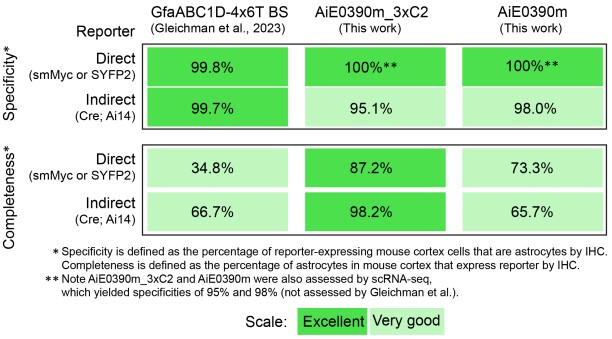
It was not the intent of our study to quantitatively compare our vectors or studies, rather to provide independent sets of reagents to allow astrocyte and oligodendrocyte marking that will provide utility to the neuroscience community. However we have provided additional characterization that adds value to the enhancer elements we studied. We characterized our best-performing vectors by scRNA-seq, in peripheral tissue (liver), across species (mouse, rat, NHP), with a known difficult transgene (NeuroD1-mCherry), with a physiologic reporter (iACH-SnFR), and in disease context (Dravet syndrome). We also found new agents that provide astrocyte regional specificity and also those that mark oligodendrocytes. We feel that having sets of tools with differing properties will provide greater flexibility in choosing one that works for many applications. As examples, it could be desired to have higher or lower expression levels for any certain applications, or possibly different levels of completeness or sparsity. Sparse labeling is particularly valuable for evaluating morphology, while dense labeling could be advantageous to deliver a ubiquitous therapeutic. Having multiple validated tools enables this flexibility and support the whole field.
Finally we would like to highlight that the enhancer elements we describe here are fully complementary to the existing sets of glial tools, including GfaABC1D and the 4x6T elements described by Gleichman et al. Importantly, enhancer elements are fully compatible with microRNA-binding sites like 4x6T, so combinations of these elements can provide fine control over targeted cell types. Furthermore, some enhancers provide different types of responses to cell states. AiE0390m has activity that is unperturbed by Dravet syndrome epilepsy, unlike GfaABC1D which expresses more strongly and in some neurons in this disease (Figure 8). This is similar to the IREN5 element described recently which activates in gliotic astrocytes near sites of damage (Zamboni et al.). Therefore, enhancer activities will help the field target and manipulate astrocytes and other glial cells in differential pathological disease states. As a result of these extra layers of flexibility, we anticipate that these enhancers will become tools for marking and manipulating astrocytes and enhancers in unforeseen ways. To help adoption in the community, detailed characterization of these and all related Allen Institute enhancer-AAV vectors are now available online in an easy-to-use resource (Allen Institute Genetic Tools Atlas at https://brain-map.org/bkp/experiment/genetic-tools/genetic-tools-atlas).
We have also added new references and reframed the introduction and discussion of this work to provide a more current survey of the glial field.
Reviewer #2 (Public review):
Enhancer elements are regulatory DNA sequences that are capable of driving specific expression patterns. As these elements are generally short and context-independent, enhancers can be used in expression vectors (e.g., packaged in an adeno-associated virus, AAV) to limit expression to target cell populations. This approach was identified as a major strategy for cell-type-specific manipulation in the brain and has been pursued by both standard research studies as well as large-scale efforts led by the BRAIN Initiative. This manuscript describes a major effort to generate enhancer-AAVs targeting astrocytes and oligodendrocytes orchestrated by a large research team led by the Allen Institute for Brain Science. This manuscript parallels other recent publications describing sets of enhancerAAVs, following rigorous, similar methods with relatively broad testing and application.
To identify and screen candidate enhancers, the scientists prioritized candidates via analysis of single-nucleus accessibility and methylation datasets (i.e., snATAC-seq) and tested them in mice. The scientists prioritized candidate enhancers that exhibited specificity of accessibility in the target cell type. Following selection, the scientists cloned the candidate sequences into AAV vectors with a minimal promoter and reporter gene, packaged the virus, delivered it to the mouse brain, and screened for activity based on reporter expression. Candidates that passed initial screening were further characterized via imaging and sorting, followed by single-cell RNA-seq. This process had around a 50% success rate and yielded 25 astrocyte and 21 oligodendrocyte enhancer-AAVs with the targeted cell-type-specific expression patterns.
The scientists went on to test for subtype-specific activity patterns, finding wide diversity in astrocyte activities across sub-populations and conversely, homogenous oligodendrocyte activation. They optimized a few of these via concatenating the enhancer core sequence to increase expression levels of the reporter gene and showed strong specificity and completeness of cell targeting for a set of these enhancer-AAVs. Following characterization and validation, they then deployed these enhancer-AAVs in a number of demonstration applications to show the utility for basic and translational science. All the constructs developed here are available for public use via Addgene, ensuring that these new tools can be used by other researchers.
There really are no obvious weaknesses in the work presented here, from the generation of the enhancer-AAVs to use in sophisticated validation studies. The enhancer-AAV testing is rigorous and provides critical information necessary for other scientists to select and use these constructs. The applications demonstrate the power of enhancer-AAV approaches. The toolbox presented here may not enable specific targeting of all relevant cellular subtypes or activity states for astrocytes and oligodendrocytes, and future work will be needed to fully understand the activity of the enhancers, identity of the target cell types, and context-dependent utility of these constructs. However, the set of enhancer-AAVs developed here should be transformative for researchers working on accessing and manipulating these cell types and have a major impact on the field.
We thank Reviewer 2 for their positive feedback. We would like to re-emphasize that these enhancer-AAV sequences are all publicly available for research use through Addgene, with characterization data beyond what we have presented here is available publicly on Allen Institute Genetic Tools Atlas. Further these tools have already been in use in multiple other publications. We are eager to see how the research community makes use of these tools.
Recommendations for the authors:
Reviewer #1 (Recommendations for the authors):
My main suggestion is that the authors should try to make their library less of a catalogue and more focused on delivering one or two enhancer-AAVs that surpass existing ones, thus effectively delivering a new tool with great utility to the field. To achieve this, authors should pick their best candidate AAVs and evaluate them systemically across all the criteria, with side-by-side comparison to two benchmarks: the classic GFAP promoter AAV, and the 4x6T AAVs developed by Gleichman et al (PMID: 37973910).
Thanks for the recommendation. Figures 2P, 5K, 6, 7, and 8 show comparison of our best astrocyte enhancer elements (AiE0390m and AiE0390m_3xC2) to GFAP promoter GfaABC1D. This work was done prior to the Gleichman et al. study so GfaABC1D-4x6T was not available at the time for direct comparison. However, as shown in Author response image 1, our data with AiE0390m and AiE0390m_3xC2 are comparable to that shown for GfaABC1D4x6T. Additionally we compared our enhancer-AAV vectors to the proB12 enhancer element described by Juttner et al. (Figures 2P and 5L), and again our enhancer-AAV vectors compare similarly. Finally, we also compared our oligodendrocyte-specific enhancers to the MBP promoter and we find our enhancers strongly outperform that promoter element in terms of specificity and completeness (Figure 3P and 5M). Overall, we have compared our new enhancer elements against reagents commonly used in the field, using established criteria for benchmarking effectiveness.
Despite the effort put towards quantification and benchmarking, we believe there is significant value to having a variety of diverse and orthogonal tools in the field. Although GfaABC1D is an excellent promoter tool and maintains strong specificity under homeostatic conditions, it changes its character in different contexts. It took years and difficult experiments to realize this and caused investigators to believe astrocytes can differentiate into neurons with the right transgene. We confirm that the reality is this promoter changes activity when it expresses the NeuroD1 transgene (Fig. 6). Also, we demonstrate AiE0390m3xC2 maintains faithful astrocyte expression (Fig. 6). In a more recent example, Zamboni et al. showed that AiE0380h is downregulated in activated astrocytes. This isn’t an experiment we conducted and were not aware of that property. However, having multiple strong tools is a huge advantage when evaluating astrocytes and oligodendrocytes in different disease states and different experimental contexts. Investigators with only one or two tools available are at the mercy of the quirks of the tool. In this way, having a large collection of astrocyte and oligodendrocyte tools available is a major advantage to researchers that need a viral tool for glial expression in a new context. And importantly, as we show for hepatocytes (Fig. 7), investigators can predictions if any of our tools will change activity in different experimental contexts if epigenetic data is available. This prediction is not possible with promoters.
For instance, 0390m is described as their best candidate but its efficiency is very low (~60%, Fig.10I). The concatenated version (AiE0390m_3x2C) is greatly improved, but it was not thoroughly evaluated: no data are provided regarding how its characteristics are maintained in disease context, its expression in other organs when delivered intravenously, or how it would be classified in Fig.2. Most notably, despite being engineered for RO injection, it was tested ICV in Fig. 9, missing an opportunity to demonstrate ease of use.
As shown in Author response image 1, the efficiency (we prefer the term “completeness” since “efficiency” conflates labeling extent with expression level) we observed for AiE0390m is actually similar to or better than that observed for GfaABC1D-4x6T. AiE0390m_3x2C shows a still greater completeness of labeling, at the expense of a slightly diminished specificity with indirect reporter (Cre; Ai14). We have amended the colored bar graphs to write the observed completeness values directly in the figure for clarity.
We have not tested this tool in the context of disease or the background expression in liver since the point of the manuscript was to present a library, not one specific tool. These are important experiments for a user focused on epilepsy or gene therapy to independently evaluate.
Several sections of the text include claims or descriptions that are misleading and should be revised. This applies both to conclusions drawn from the presented data and to the framing of the field of glial biology.
(1) Overstated/misleading conclusions: Segments such as "this collection of glial enhancer-AAVs will enable characterization of astrocyte and oligodendrocyte populations and their roles across species, disease states, and behavioral epochs" are unfounded based on the current library authors present and need to be revised. The conclusion that 2120m and 2160m are labeled "mutually exclusive regions" is misleading too, and no information is available on the specificity of 2160m. Similarly, the claim that the new AAVs are more predictable "across disease states" is a stretch, considering that a single disease model was employed. These are only examples.
Thank you for the suggestions. We have amended the language in our manuscript as suggested to improve the accuracy and clarity of our claims, and limited our interpretation to one mouse model of epilepsy. AiE2160m predominantly labels subtelencephalic astrocytes (Figure 2—Figure Supplement 3) of the molecular taxonomy label “5109-AstroNT NN_3” (Figure 4D; taxonomic labels from Yao et al., 2023 PMID 38092916). However, we do strongly believe that this collection of tools, admittedly incompletely validated, will serve as an excellent starting point for investigator who need tools tailored to their biological need.
(2) Outdated description of the field of glial biology: The text contains multiple segments that are incredibly dismissive of the current state of glial research. Sentences such as "Astrocytes provide trophic support for neurons, coordinate regional wiring patterns, respond to and regulate neurotransmission", or "this suggests that the astrocytes help selectively maintain glutamate or GABA tone depending on the local neurotransmitter balance" are incredibly reductive and dissonant with the reality of what the field has achieved, both conceptually and technically, and seem shockingly siloed from the past1520 years of research. This dramatically taints the credibility of what the authors have achieved and needs to be revised.
Thank you for the constructive criticisms. Our language was intended to highlight the importance of glial cells without providing a comprehensive review. However the examples and wording did tilt toward passive roles and outdated references, whereas much recent work shows active instructive glial roles in regulating neural circuits. We have revised the language and added more recent examples/citations to reflect the chief roles that astrocytes play in the healthy brain.
(3) The framework used to assess specificity and completeness would benefit from being more systematic, clear, and aligned with standards in the field.
Thank you for the criticism. We have made our definitions of “Specificity” and “Completeness” more clear in the text. We have also added numerical text to our bar graph color presentation of completeness levels in Figures 2, 3, and 5 for easier interpretation. As shown in Author response image 1, our metrics are equivalent and comparable to those presented previously by Gleichman et al.
(4) The apparent lack of core expertise in biology is detrimental to methodology. The authors seem unaware of the extreme stringency in the field: a 'specificity' of 80% would be considered extremely poor, and 90% would be merely acceptable. The bar for what the field typically expects for astrocyte-targeting is upward of 95%, usually close to 98-99%. See PMID: 37973910 as an example.
We are happy that all of our best astrocyte-specific enhancer-AAV vectors (AiE0380h, AiE0390m, AiE0390h, AiE0387m, AiE0390m_3xC2, AiE0390h_3xC2, AiE0387m_3xC1) showed typical specificities of 98-99% or more. This was assessed by both IHC and scRNAseq. As one example, AiE0390h showed 452/454 cells positive by IHC (99.6% specific), and 86/86 sorted cells by RNA-seq (100% specific). This was data from two different animals in each assay (four total). In some assays we observed literally 100% specificity (807/807 labeled cells were astrocytes by IHC for AiE0390m). We made similar observations with the best oligodendrocyte-specific vectors (AiE0410m, AiE0641m, AiE0395h, AiE0397m, AiE0410m_3xC2). Moreover, it is not common for investigators to use transcriptomics to assess specificity in addition to histology.
(5) AAVs with specificity above 95% could thus be labeled "specific," but all others should be considered "not specific" (perhaps with a gradation "poorly specific" for 95-90% and "not specific" below 90%). Either way, the category "mixed specificity" makes little sense.
We are happy that all of our best astrocyte-specific enhancer-AAV vectors (AiE0380h, AiE0390m, AiE0387m, AiE0390m_3xC2, AiE0390h_3xC2, AiE0387m_3xC1) showed specificities of 98-99% or more, and only cells with astrocyte morphology observable throughout the brain. Other vectors were highly specific in cortex but also strongly labeled neurons in other regions; for example, AiE2118m shows strong and specific (>99%) astrocyte labeling in VISp, but changes specificity to isolated neuron populations in other regions like midbrain and medulla. Hence it has a “mixed” specificity profile. We have edited the text to clarify this grouping. Additionally, we hope that the matrix we provide in the new Figure 2—Figure Supplement 2 will aid in interpretation of regions where specificity is high and where specificity is low.
(6) The tables that the authors provide (Figure 2 and Figure 2 Supplement 1) currently mix notions of specificity with notions of completeness, making it extremely difficult to assess the utility and quality of any of the AAVs. Instead, they should be separated, with first an assessment of specific and then an assessment of completeness/regionality only for those AAVs that are fully specific. Alternatively, authors could present their results as a matrix.
We have amended the colored bar graphs to state the observed completeness levels directly in Figures 2, 3, and 5, rather than only as color scales as previously shown. We believe this improves the interpretability of the figure.
(7) A more rigorous and useful way to assess CNS-wide or regional expression would be to provide quantitative region-by-region data with color-coded z-scoring per region, combined with meaningful descriptors (e.g., "Forebrain + cortex" instead of "most brain"). This could be a matrix with regions listed at the top and AAVs vertically.
We thank the reviewer for the suggestion. We have added this suggested matrix as Figure 2—Figure Supplement 2. We hope it aids in interpretation of the data.
(8) The criteria used for the classification of AAVs seem confusing or misleading. For example, AiE0390h is described as "CNS-wide" but then highlighted for its lack of expression in the basal ganglia, making it unsuitable as a true pan-astrocyte AAV. Conversely, Ai0386m and AiE0386h, classified as "weak", show stronger expression than several of the AAVs classified under the "most CNS" category.
We thank the reviewer for the observations. Delivering AAVs IV via PHP.eB routinely target basal ganglia structures including striatum less efficiently than other parts of brain including cortex. This was quantified in our recent publication using molecular barcodes, and is true regardless of targeting neurons or oligodendrocytes or astrocytes in this region (approximately ½ log lower transduction as shown in Supplementary Figure 7a, 7c; Hunker et al., 2026 Nat. Comm. PMID 42049725). This is reflected in the current dataset of weaker expression in striatum and other related structures with each of the astrocyte or oligodendrocyte-targeting AAVs including GFAP promoter. However, some signal is present in striatal astrocytes with AiE0390h. On data review the example full-stitch images given for AiE0386m/h were not representative of average signal intensity across replicates, whereas the inset images were representative. In this resubmission we have swapped images for 386h and 386m in Figure 2—Figure Supplement 1 with more representative full-size images. We hope this has increased the interpretability of the dataset. Importantly we assessed fluorescence levels from enhancer-AAV vectors by multiple techniques: microscopy, immunohistochemistry, flow cytometry, and scRNA-seq.
(9) Additionally, a concern is that the regional specificity reported for some AAVs is extremely loose, which seems to be of limited practical use. It would be more impactful to focus on a couple of truly non-overlapping AAVs with genuine potential, and thoroughly assess whether, injected together, they could be used to express distinct cargos (effectors or reporters) into distinct populations, layers, or regions with no or minimal overlap. This could include 2120m and 2121m, which may hold promise for targeting subregions of the basal ganglia (though, because they also express outside of the BG, a follow-up experiment involving stereotaxic injection into these regions would be needed to test whether regional specificity is preserved with that route of delivery). Similarly, AiE0381h seems oddly specific to the CA2 of the hippocampus, and this could be very useful. These additional experiments could open the way to cell-type-specific combinatorial strategies, which would represent a monumental technical leap for the field.
Thank you for the insightful comment. Although we agree that the suggestions of multiplexing two enhancer-AAV vectors with different specificities has high significance, we have done similar multiplexing work and unfortunately at present it is not yet predictable which combinations will work for multiplexing. Some combinations do work and others do not. For examples see Figures 7 and S9 of Hunker et al., 2025 Neuron PMID 40403704. Because of the complication of interpreting results, we have decided not to pursue these experiments in this manuscript. We have added text to the discussion to highlight the future unrealized possibility of multiplexing enhancer-AAVs.
AiE0381h has background expression in CA2 projection neurons, which is a frequent site of off-target labeling for AAV9-derived vectors in enhancer and capsid screens. As one example Nonnenmacher et al. observed frequent CA2 neuron-enriched expression in a capsid screen (PMID: 33553485 Figure 5B). As another example we observe off-target labeling in CA2 with AiE2119m as well (Figure 2—Figure Supplement 1). It is unclear what makes CA2 neurons unique in this way, and it is unclear why it is the most prominent for AiE0381h in this set. Regardless, we have demarcated the off-target CA2 site of expression in Figure 2—Figure Supplement 1, along with other off-target sites of expression from other vectors, and noted it in the figure legend.
(10) The "sparse" AAVs (which authors labeled "scattered") should not be dismissed. It would be worth assessing whether astrocytes expressing these AAVs map onto specific molecular signatures, i.e., these AAVs target a very specific population of sparse astrocytes in various regions. This would be of substantial benefit to the field, allowing subpopulation-specific molecular characterizations (e.g., TRAP) or functional manipulations via chemogenetic actuators (e.g., DREADDS).
We thank the reviewer for this important highlight. We too are fascinated by the enhancerAAVs that show sparse/scattered labeling patterns. We have confirmed that the sparse labeling pattern is reproducible with multiple replicate animals tested per vector, and reproducible across orthologous pairs, with the best example being AiE0374m (mouse ortholog) and AiE0374h (human ortholog) both showing this sparse expression pattern. Our interest led us to conducting single cell RNA-seq profiling studies to see if we could see any clear molecular distinctions of the labeled cells (compared to other labeled astrocytes. However, we did not observe any gene expression differences using scRNA-seq when comparing the sparse AiE0374m-labeled cortical astrocytes to cortical astrocytes labeled by enhancer-AAV vectors that broadly labeled cortical astrocytes (Fig. 4A). Furthermore, tools for locating transcription factor binding motifs (MAST) did not elucidate any obvious unique transcription factor that defined this group of enhancer-AAVs (not shown). As a result the molecular interpretation of the sparse expression patterns is not yet known. We cannot say what distinguished these astrocytes from others, but the phenomenon inspires further experimentation that is beyond the scope of this study. We provide these data and vectors to the field in hopes of it enabling unique experiments to better understand this population, as well as conduct experiment where sparse astrocyte labeling is valuable. We have edited the text to call this set “Sparse” and highlight these possible use cases in the discussion.
Other concerns:
(1) Terms such as cell type vs. subtype or subpopulation are not used adequately.
(Astrocytes are a cell type, and protoplasmic astrocytes are a subtype of astrocytes.)
We are following the nomenclature of molecular taxonomies of brain cells (example references Yao et al., Nature 2023 PMID: 38092916; Siletti et al., Science PMID: 37824663; Zu et al., Nature 2023 PMID: 38092917). This nomenclature has the advantage of linking molecular information to enhancer discovery and the eventual targeting of every brain cell type with this technology.
(2) Considerations about the effect of viral titers would be important.
We deliver a constant dose of 5e11 vg per animal, irrespective of production titer.
Production titers ranged from 4.47e12 to 1.47e14 gc/mL, interquartile range 3.13e13-6.55e13 gc/mL, mean 5.10e13 gc/mL, n = 215 total viral preps. This detail has been added to the
methods.
(3) A stronger articulation to distinguish this paper from the prior publication in Cell [PMID: 40403729] would be needed.
We focus our characterization of the vectors across species, organs, disease states, and with difficult non-reporter vectors. The prior paper was focused on a larger breadth of testing with a publicly accessible database attached, whereas this paper constitutes a deeper dive into the properties glial cell targeting reagents. We have added additional text in discussion to highlight the differences between the manuscripts. Furthermore, Supplementary Table 2 shows the additional experiments added in the current study which allows deeper characterization of these glial cell-targeting collections. We strongly believe the community is best served by our deep dive into glial enhancer discovery and evaluation of these tools.
(4) The NHP data is highly significant, but here again, it is missing benchmarking against established tools such as 4x6T.
Since Gleichman did not test their element in NHP it is not validated in NHP. It may or may not work there. Our enhancer elements, by virtue of being selected for conservation of activity across mammalian species, are predicted to work across mammalian species, and many of them in fact do work across mammalian species. Besides GFAP promoter (references Heffernan et al., 2022 J. Neurosci. Meth. PMID: 35202614; Matsuzaki et al., 2024 MTMCD; PMID: 39391837) our enhancer elements are the only control elements validated for highly specific astrocyte expression in primate, and our oligodendrocytespecific element AiE0410m shows higher specificity than that observed for MBP promoter in primate previously (Matsuzaki et al., 2024 MTMCD; PMID: 39391837).
(5) Figure 5 M is never cited.
Thank you for the comment. We cite Figure 5M on line 233 of the revised manuscript.
Reviewer #2 (Recommendations for the authors):
I have no recommendations for the authors. This work is rigorous, broad in scope for testing, validation, and application, and overall an exceptional and significant piece of work.
We thank Reviewer 2 for their positive comments.
-

-
-

-
-
-
-
-
eLife Assessment
This important study presents convincing findings on creating an exhaustive library of new enhancer-AAVs targeting astrocytes and oligodendrocytes with high potential for both basic and translational work, which will be of value to a large and growing community. However, the outdated description of glial biology in the Introduction, the overstated claims of utility in the Conclusion, and the loose stringency in the criteria used to assemble the library diminish the strengths of the claims. The work will be of interest to neuroscientists working on glial cell biology.
-
Reviewer #1 (Public review):
The goal of this study was to generate a library of new enhancer-driven AAVs in order to selectively and efficiently target astrocytes and oligodendrocytes in rodents. The implied criteria are that such viral vectors should have high specificity for the intended cell type and effectively express in all astrocytes/oligos in the brain or, alternatively, be specific for defined brain regions, layers, or subtypes of astrocytes/oligos. In addition, they should be compatible with intravenous retro-orbital delivery to facilitate experimentation and brain-wide targeting (i.e., show organ specificity and high efficiency in the brain). Ideally, these new AAVs would also maintain their characteristics across disease contexts and show applicability in non-human primates. Tools with such characteristics are generally …
Reviewer #1 (Public review):
The goal of this study was to generate a library of new enhancer-driven AAVs in order to selectively and efficiently target astrocytes and oligodendrocytes in rodents. The implied criteria are that such viral vectors should have high specificity for the intended cell type and effectively express in all astrocytes/oligos in the brain or, alternatively, be specific for defined brain regions, layers, or subtypes of astrocytes/oligos. In addition, they should be compatible with intravenous retro-orbital delivery to facilitate experimentation and brain-wide targeting (i.e., show organ specificity and high efficiency in the brain). Ideally, these new AAVs would also maintain their characteristics across disease contexts and show applicability in non-human primates. Tools with such characteristics are generally lacking in studying glial cells and would be extremely useful to scale up and accelerate glial research, allowing targeting of astrocytes/oligos with distinct molecular identity and intersectional strategies.
At present, however, none of the enhancer-AAVs presented in the study seems to meet this combination of criteria, at least not with the level of stringency typically expected in the field. The main reason is that, in its current form, the study does not present one candidate AAV iteratively improved to meet all these criteria; instead, it presents a catalogue of new AAVs with various degrees of specificity, completeness, and mixed characteristics. Therefore, their utility should be interpreted cautiously. Moreover, the way specificity and completeness are intermixed in the analysis makes it difficult to evaluate the actual utility of any given AAV. The study might have been strengthened by focusing on a small set of the most promising candidates (i.e., AiE0890m_3x2C) and validating them thoroughly for expression specificity, completeness, effective cargo expression, ability to allow specific pan-astrocyte or astrocyte-subtype targeting in vivo, and preserved properties in NHPs and in disease, as this would encourage their adoption by the community. Currently, too many AAVs are assessed inconsistently against the desired criteria, with none being evaluated through and through.
The impact of the catalogue is also greatly diminished by the fact that a suite of AAVs with outstanding specificity and efficiency is already available for the study of astrocytes (e.g., 4x6T AAVs) and was not utilized as a standard to benchmark the new library, making it difficult to appreciate the relative benefits of the new AAVs. The inclusion of expression data in NHPs is very significant, but benchmarking against established AAVs would also be needed to fully appreciate their value.
Importantly, readers should also be aware that the study seems noticeably limited in its literacy with glial biology. The introduction and discussion frame the field in a way that seems outdated, creating the impression that the diverse roles of glia in health and disease have not yet been studied, which may inadvertently be perceived as dismissive and stigmatizing.
In summary, the paper introduces potentially useful viral tools and lays the foundations for future multiplexed targeting of distinct glial cell subpopulations in rodents and in non-human primates, which are extremely important directions. Some of the regionally restricted or even sparsely expressed AAVs may prove valuable in enabling subpopulation-specific targeting or molecular profiling strategies, but currently lack full benchmarking. At present, the promises over the utility of the new tools seem overstated, and the library may not yet represent an actionable resource for targeting astrocytes and oligodendrocytes.
-
Reviewer #2 (Public review):
Enhancer elements are regulatory DNA sequences that are capable of driving specific expression patterns. As these elements are generally short and context-independent, enhancers can be used in expression vectors (e.g., packaged in an adeno-associated virus, AAV) to limit expression to target cell populations. This approach was identified as a major strategy for cell-type-specific manipulation in the brain and has been pursued by both standard research studies as well as large-scale efforts led by the BRAIN Initiative. This manuscript describes a major effort to generate enhancer-AAVs targeting astrocytes and oligodendrocytes orchestrated by a large research team led by the Allen Institute for Brain Science. This manuscript parallels other recent publications describing sets of enhancer-AAVs, following …
Reviewer #2 (Public review):
Enhancer elements are regulatory DNA sequences that are capable of driving specific expression patterns. As these elements are generally short and context-independent, enhancers can be used in expression vectors (e.g., packaged in an adeno-associated virus, AAV) to limit expression to target cell populations. This approach was identified as a major strategy for cell-type-specific manipulation in the brain and has been pursued by both standard research studies as well as large-scale efforts led by the BRAIN Initiative. This manuscript describes a major effort to generate enhancer-AAVs targeting astrocytes and oligodendrocytes orchestrated by a large research team led by the Allen Institute for Brain Science. This manuscript parallels other recent publications describing sets of enhancer-AAVs, following rigorous, similar methods with relatively broad testing and application.
To identify and screen candidate enhancers, the scientists prioritized candidates via analysis of single-nucleus accessibility and methylation datasets (i.e., snATAC-seq) and tested them in mice. The scientists prioritized candidate enhancers that exhibited specificity of accessibility in the target cell type. Following selection, the scientists cloned the candidate sequences into AAV vectors with a minimal promoter and reporter gene, packaged the virus, delivered it to the mouse brain, and screened for activity based on reporter expression. Candidates that passed initial screening were further characterized via imaging and sorting, followed by single-cell RNA-seq. This process had around a 50% success rate and yielded 25 astrocyte and 21 oligodendrocyte enhancer-AAVs with the targeted cell-type-specific expression patterns.
The scientists went on to test for subtype-specific activity patterns, finding wide diversity in astrocyte activities across sub-populations and conversely, homogenous oligodendrocyte activation. They optimized a few of these via concatenating the enhancer core sequence to increase expression levels of the reporter gene and showed strong specificity and completeness of cell targeting for a set of these enhancer-AAVs. Following characterization and validation, they then deployed these enhancer-AAVs in a number of demonstration applications to show the utility for basic and translational science. All the constructs developed here are available for public use via Addgene, ensuring that these new tools can be used by other researchers.
There really are no obvious weaknesses in the work presented here, from the generation of the enhancer-AAVs to use in sophisticated validation studies. The enhancer-AAV testing is rigorous and provides critical information necessary for other scientists to select and use these constructs. The applications demonstrate the power of enhancer-AAV approaches. The toolbox presented here may not enable specific targeting of all relevant cellular subtypes or activity states for astrocytes and oligodendrocytes, and future work will be needed to fully understand the activity of the enhancers, identity of the target cell types, and context-dependent utility of these constructs. However, the set of enhancer-AAVs developed here should be transformative for researchers working on accessing and manipulating these cell types and have a major impact on the field.
-
-
-